Forex for beginners in 2026
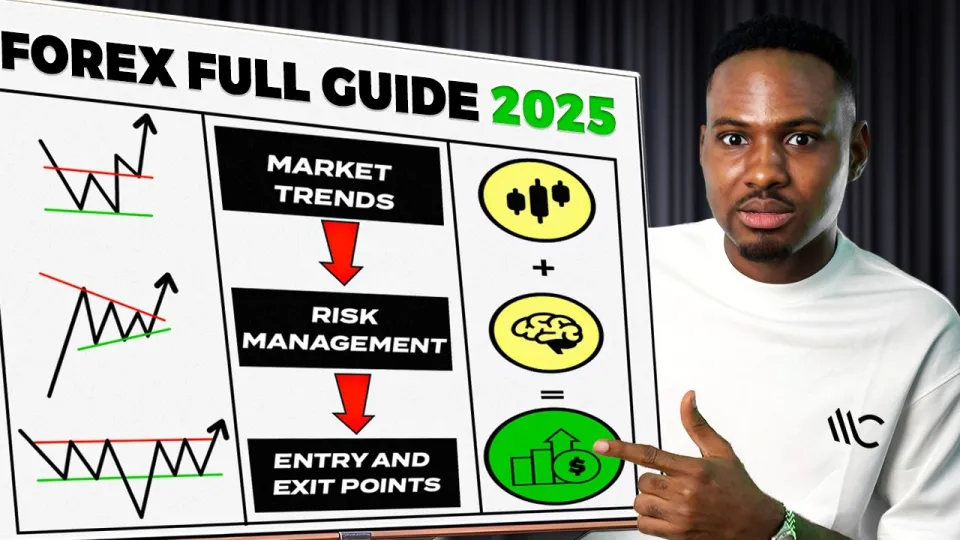
Video: How To Start Forex Trading For Beginners’ 2025 (Full Course)
Want articles like this for your own video to promote it on YouTube and Google? Order them through the Telegram bot @sat_sit_bot. Articles with your video embedded are written and posted by the bot itself — on popular topical sites (no ads). Free trial — 50 articles.
· based on the channel Jeffrey Benson Forex
Forex for beginners is best learned as a structured course rather than as scattered clips: you need the market mechanics, the tool stack, a simple strategy foundation, a first supervised trade and a risk rule before you risk real money. The full-course format used by Jeffrey Benson Forex walks through exactly those blocks in order, and students who want the trainer's own materials can start at the Fire Pips FX plans page. Watching in sequence matters more than watching a lot, because each block assumes the previous one.
What forex actually is and how the market is organised
Forex is the global market for exchanging one currency for another, quoted in pairs where the first currency is the base and the second is the quote. When you see EUR/USD at 1.0850, one euro buys 1.0850 US dollars, and a standard lot of 100,000 units moves $10 per pip — that arithmetic is the foundation for every position-size calculation later.
Unlike stocks, there is no central exchange. Trading happens over the counter through a network of banks, brokers and liquidity providers, which is why spreads and execution differ between brokers and why the broker choice is a real decision rather than a formality.
The market runs 24 hours a day from Sunday evening to Friday evening (UTC), split into four sessions: Sydney, Tokyo, London and New York. Liquidity and volatility concentrate when London and New York overlap, while the late Asian session is typically the quietest — a practical filter for anyone choosing when to sit at the screen.
The tools a beginner needs before the first trade
A working beginner setup is small: a regulated broker account, a trading platform, a demo account, an economic calendar and a journal. Everything else is optional until the basics are automatic.
The platform of choice in most beginner courses, including this one, is MetaTrader 5 (MT5): it provides charts, order types, indicators and a demo mode that mirrors live conditions. The broker is where the money sits, so regulation, spreads, minimum deposit and withdrawal rules deserve more attention than bonus offers.
- Open a demo account and treat it as a simulator, not a game — same lot sizes, same risk rules as planned for live trading.
- Learn four order types: market, limit, stop and stop-limit, plus stop-loss and take-profit attached to every position.
- Set up an economic calendar and mark high-impact releases (central bank decisions, CPI, non-farm payrolls) so you are never surprised by a spike.
- Keep a journal from day one: pair, session, reason for entry, risk in pips, outcome and one line on what you would repeat.
Building a simple strategy foundation instead of collecting indicators
A beginner strategy is a repeatable rule set for when to enter, where to exit and how much to risk — not a pile of indicators. The course's strategy block is built on that logic: identify the direction from higher timeframes, wait for a defined level or pattern, then execute with a pre-set stop.
Practical starting rules that survive contact with a live chart:
- Pick one or two pairs (EUR/USD and GBP/USD are the usual beginner choices because spreads are tight) and learn their behaviour before adding more.
- Trade one timeframe for entries and one higher timeframe for context — for example, four-hour for direction and fifteen-minute for entries.
- Define a stop-loss in pips before entering, based on structure rather than on how much you are willing to lose.
- Cap risk at 1% of account equity per trade; at 1% risk, ten consecutive losses cost roughly 10% of the account, which is survivable, while 10% risk per trade ends most accounts within that same streak.
- Set a daily loss limit and a weekly one, and stop when either is hit.
Placing the first trade step by step
The first trade should be placed on demo with a written plan, so execution becomes mechanical rather than emotional. The sequence is the same on live money later.
- Check the calendar for high-impact news in the next hour and avoid opening a position into it.
- Mark the higher-timeframe direction and the level you care about.
- Calculate lot size from your stop distance and your 1% risk budget, not from the leverage your broker offers.
- Place the order with stop-loss and take-profit attached in the same ticket.
- Screenshot the chart and write the journal entry while the trade is open.
- Review the result against the plan, not against the profit.
Common beginner mistakes and the questions they produce
Most beginner losses trace back to a handful of repeatable errors, and the audience reaction to beginner courses shows the same worries again and again: fear of starting, confusion about risk management, and impatience to fund an account.
- Skipping the demo phase. New traders want live P&L immediately, then discover that emotional pressure changes execution completely.
- Oversizing positions. Leverage is not a budget; a 1:500 account can open a position that wipes equity on a 20-pip move.
- No stop-loss or a moving stop. Widening a stop to avoid a loss turns a small planned loss into an account-level event.
- Strategy hopping. Switching systems after three losing trades guarantees that no system is ever tested properly.
- Trading every session. Beginners often sit through low-liquidity hours, take lower-quality setups and burn attention before the London open.
- Following signals without understanding them. Copying trades can be a learning aid, but it teaches nothing about exits or risk if the reasoning stays hidden.
Useful links from the course author
- Fire Pips FX plans and student access — the trainer's paid programme.
- Free daily signal channel — one free trade idea per day.
- Assex Markets registration link used in the video — the broker recommended by the author.
- Premium signals help bot — subscription entry point for the premium group.
Final takeaway
A full course beats scattered tutorials because it forces an order: market mechanics, then tools, then strategy, then a supervised first trade, then risk rules. The numbers that matter most are unglamorous — 1% risk per trade, a fixed stop, a demo phase measured in weeks rather than hours, and a journal that makes every decision reviewable. Jeffrey Benson Forex structures its beginner course around exactly that progression, and the audience response suggests the sequencing is what makes it click. Use the free material to learn the framework, then decide whether a paid programme such as the Fire Pips FX plans adds anything you cannot build yourself with a demo account and discipline.
Key takeaways
- Forex is a decentralized over-the-counter market where currencies are quoted in pairs such as EUR/USD; there is no single exchange.
- Four sessions — Sydney, Tokyo, London and New York — overlap around London/New York, which is when most volume and volatility appear.
- A beginner stack is a broker account, MetaTrader 5, a demo account, an economic calendar and a trading journal.
- Jeffrey Benson Forex structures its beginner course around eight blocks, from 'What is forex' to 'Common mistakes to avoid'.
- Risk per trade is the first number to fix: most beginner blow-ups come from oversized positions, not from bad entries.
Questions & answers
How much money do I need to start forex trading?
You can start on a demo account with zero capital and learn the mechanics for weeks before funding anything. When you go live, the account size should be large enough that 1% risk equals a position you can manage — many beginners start with a few hundred dollars on a micro-lot basis, accepting that returns will be small while skills are built.
How long does it take to become consistently profitable?
There is no fixed timeline, but the realistic path runs through months of demo and small live trading, not days. The bottleneck is usually risk discipline rather than chart knowledge, so traders who journal every trade and keep risk at 1% tend to reach consistency faster than those who switch strategies weekly.
Is it safe to copy someone else's trades as a beginner?
Copying trades can reduce decision pressure but does not teach you exits, position sizing or how to handle a losing streak. If you use signals, keep the risk small, verify the broker and channel, and treat each copied trade as a case study you review afterwards rather than as a replacement for learning.
Which session should a beginner trade?
The London and New York overlap offers the deepest liquidity and the clearest moves, which suits most beginners who can be at the screen during European or US hours. The late Asian session is usually quieter and produces more false breakouts, so it is a harder place to learn execution.
Source: How To Start Forex Trading For Beginners’ 2025 (Full Course) · Markdown version